
Cardiovascular imaging and coronary disease
We investigate coronary image analysis, pathology-aware representations, and their relationship to cardiovascular risk.
How can models represent coronary anatomy and disease-related image features across imaging tasks?
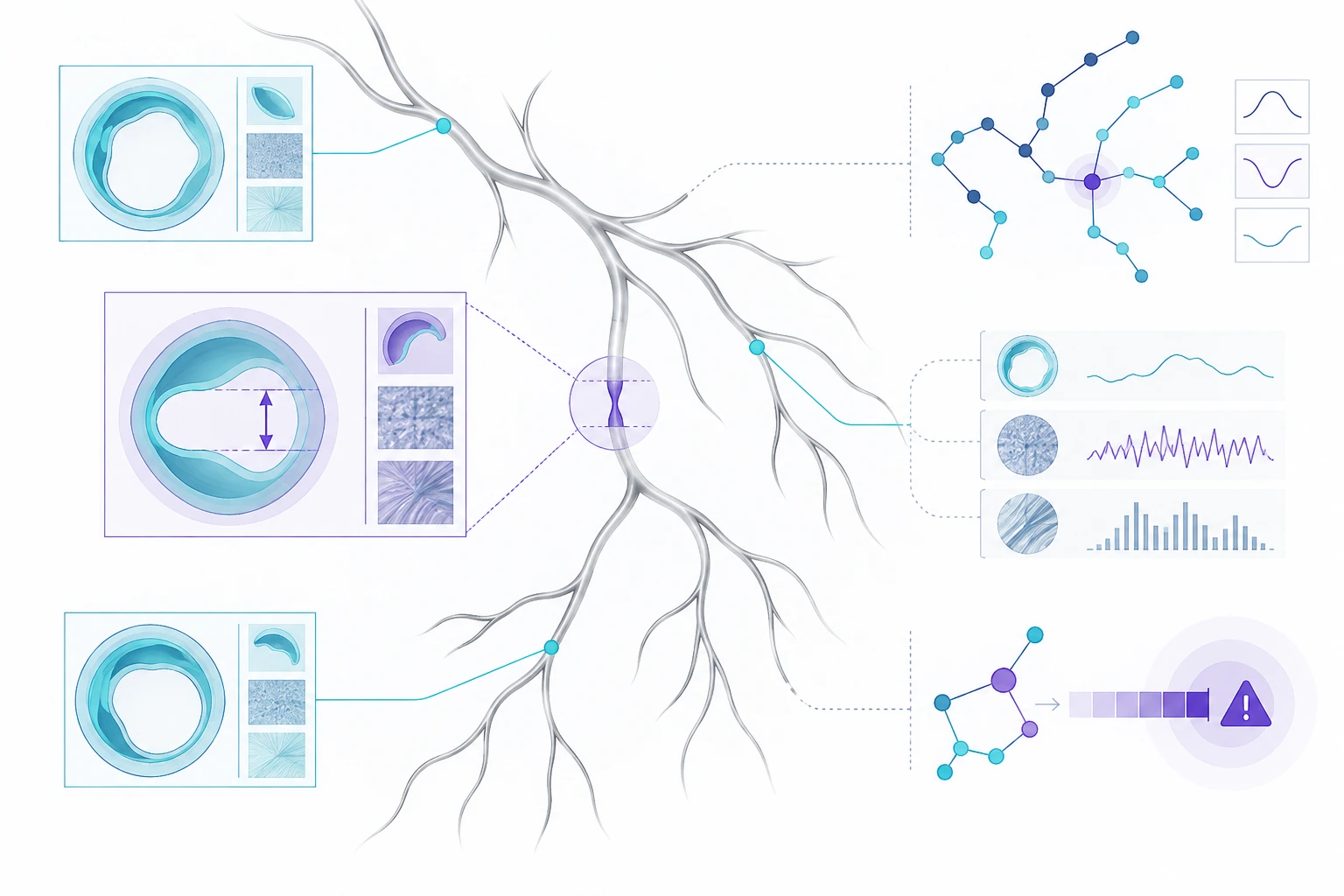
Method overview
From coronary geometry to image representations
A centerline and local regions define the coronary structure under study.
Schematic of the research approach; image patterns and measurements are illustrative.
Research overview
Coronary assessment involves both the geometry of vessels and the appearance of disease within them. Our research studies segmentation and representation learning for cardiac CT, including approaches that use anatomical information and synthetic examples to address limited annotations.
The CORA framework investigates pathology-centric representation learning from coronary CT angiography. Its research tasks include coronary artery segmentation, plaque and stenosis assessment, and risk stratification using imaging and clinical variables. The work examines whether a representation learned from disease-related features can transfer across tasks and datasets.
From coronary geometry to image representations
- Identify coronary structures and image regions relevant to plaque or stenosis.
- Learn representations using anatomical context and disease-related examples.
- Evaluate task transfer and associations with documented cardiovascular outcomes.
Selected research sources
Research enquiries
Contact the lab